“I wanted this to be easy”
Oh what a tangled web we weave, when first we practice to [write a newsletter post]
- William Shakespeare[ish]
When you get a new (required field) Productions post, it has usually been created using a simple 9-step process:
- idea!
- outline
- drafts
- final review by Mari
- last minute changes
- more last minute changes
- this is absolutely the final set of changes
- OK, one more
- post!
It’s pretty straightforward. But not all the time. Like this week.
Hey, want to see some sausage get made? Well, come with me on a tour of how I attempted to write this very issue. Up to and including the part where it turned on me.
Let's talk about art, technology, ink-based time travel, and when writing gets distrubingly like one of the deaths in Jurassic Park. It’s a newsletter post about itself, so let’s get meta!
Right after the news.
What’s going on?
- Bad, Long Covid, bad! No biscuit!
I caught COVID on day 4 of a 7-day cruise in September, and I still think I’ve got a little brain fog. Or maybe “brain fog” is now my default state. I plan to ignore my birthday this year and see if denial of aging helps. - If you know me at all, you know I’m terrible at remembering names. I call my affliction “lethonomia” (I totally made that up from the latin “letho” (forget) and “nomen” (name).)
And to encourage my fellow Lethonomics to let go of their embarrassment and just get out there and talk to people, I created Lethonomia Club. Our motto: “Quaeso me admone” (“Please remind me”):
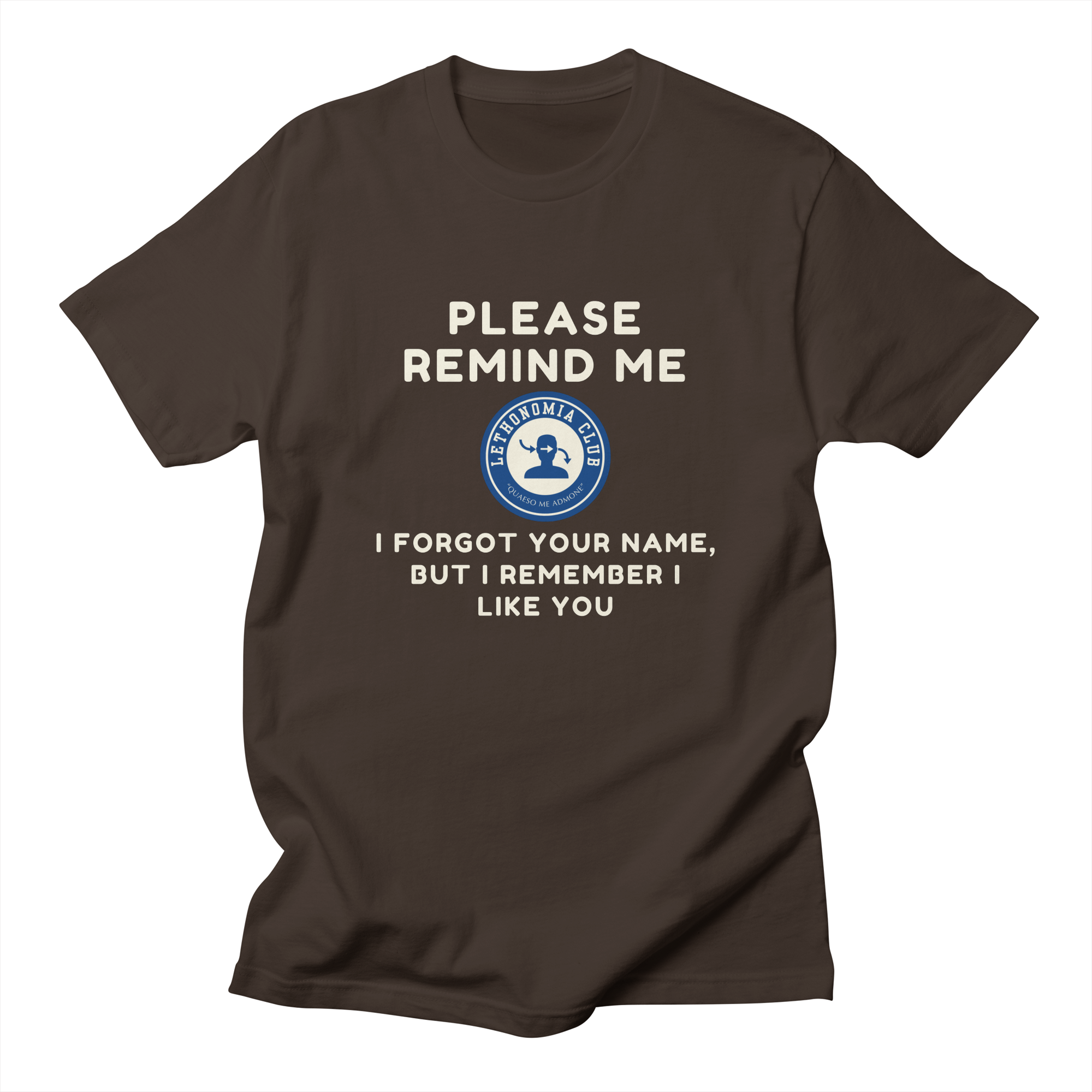
These designs and more are available at the Required Field Productions Threadless store. Are they the perfect Holiday gift? No, that’s still cash. But they are kind of fun.
A draft of many colors
This all started as a collision of analog and digital.
Analog first: I was reviewing one of my active notebooks (there are several that migrate around my office), and I came across this page. Don’t worry about the words right now. Look at the colors.
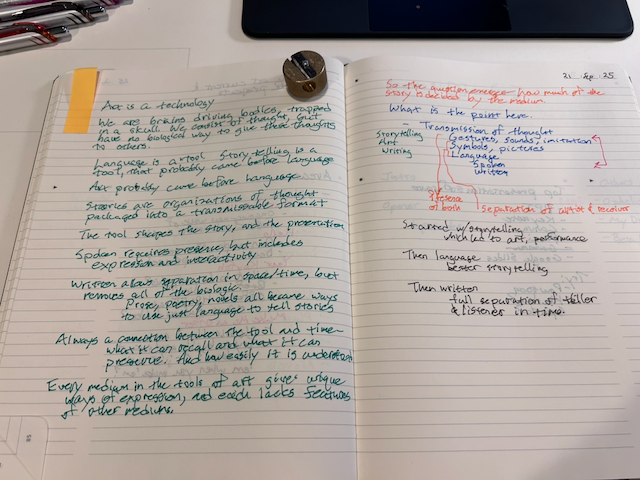
The blue ink on the right is me first writing down an idea I had. Then the orange is me coming back and tuning it a little. Then the black ink is a later attempt to get that into some sort of outline.
Then after a few weeks, on the 21st of September , I came back read the whole multi-colored thing, and thought, “Huh, maybe this is something,” and made a stab at a Draft 0.0 script. That’s all the green on the left.
This is why I love colored pens (right now I have 10 different hues on my desk). They let me turn any page into a time machine of changes, annotations, and additions.
So I ended up with the green ink text, which was still pretty much an outline. To build that out, I would need to dig in and turn it into actual sensical sentences.
The Sensical Sentence Dilemma
Unfortunately, I was on a cruise ship at the time, and this was the equipment I had with me:
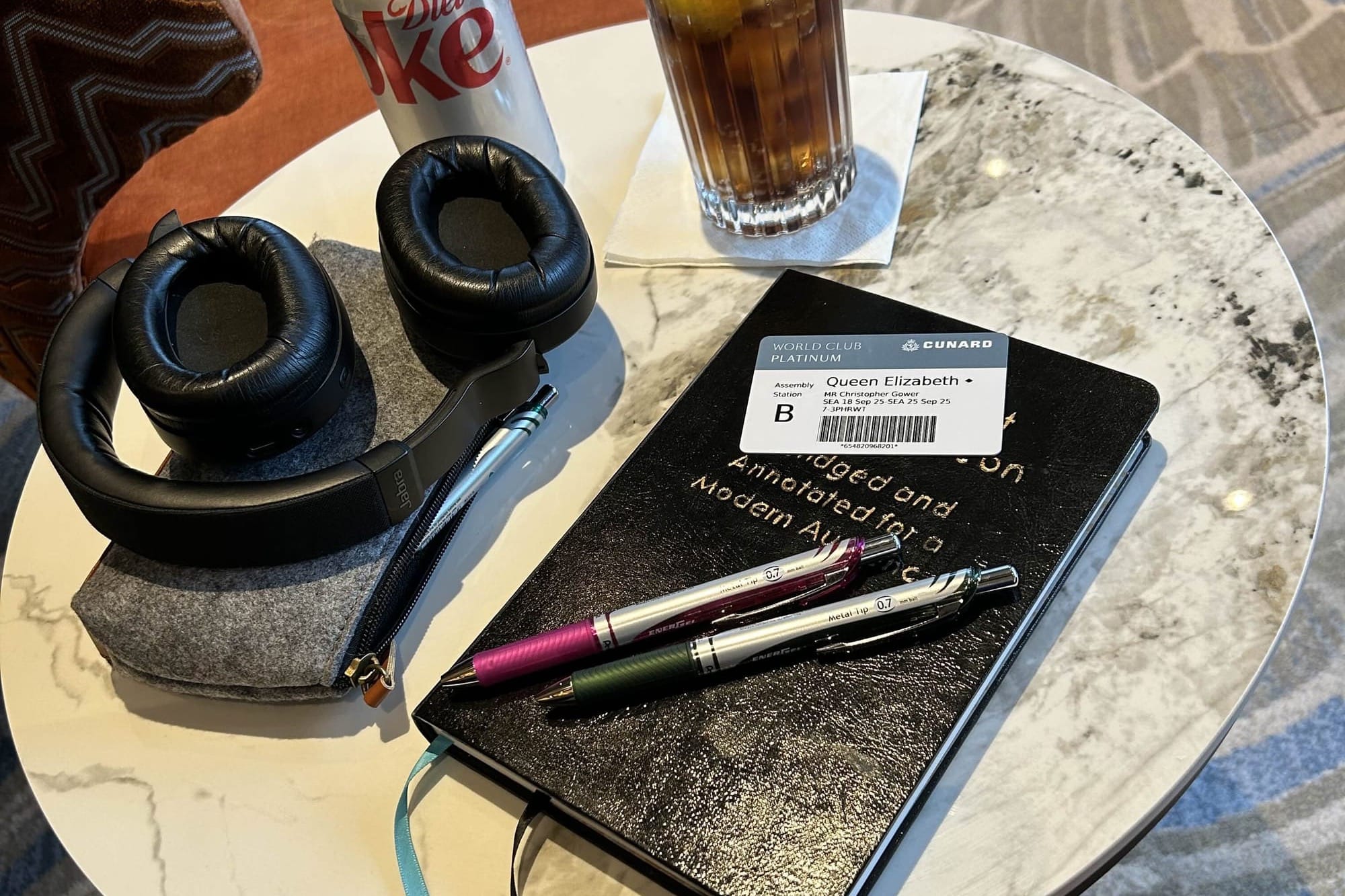
I certainly wasn’t going thumb-type the thing into my iPhone. Then I remembered the Voice Memo app.
I could use the green text as notes for a presentation, record myself delivering it as a speech, and then transcribe that from audio to text. So, back in my cabin, I opened Voice Memo and gave a Ted Talk to the North Pacific Ocean. It went pretty well.
Then, I just had to figure out how to transcribe the audio. I knew it should be possible to do that on the iPhone, what with Apple AI and all. But in the words of the immortal Dr. Seuss:
It’s fun to have fun, but you have to know how.
And I didn’t know, exactly, how. There are a surprising number of transcription methods that almost work on the iPhone. I tried most of them. Here’s the result of one attempt:
Act is a technology
trapped
to others.
Language is artor 5tore guan
toot, that probadly came
Art probly came before hanguage.
Staerich are orgarizations ot thought packaged into a trargmissabe format The tool shopes the story, and the presentatio Spoken requires presence, but incades expression ard interactivity
It’s true what they say: “AI gives you infinite interns.” Sure, it works fast, but you really have to check it for errors.
Two or three tries later, I finally managed to get the iPhone to give me a cleaner copy of the text – maybe 90% accurate. I copied that to a document, corrected a bunch of weird assumptions on the part of the transcription tool, and then did some minimal edits.
Finished!
Or are there?
The draft ended up just 273 words long. That is to my usual essay what water skiing is to scuba diving – a fast skim across the surface. So I decided to dig in a little and expand on the draft.
And then...
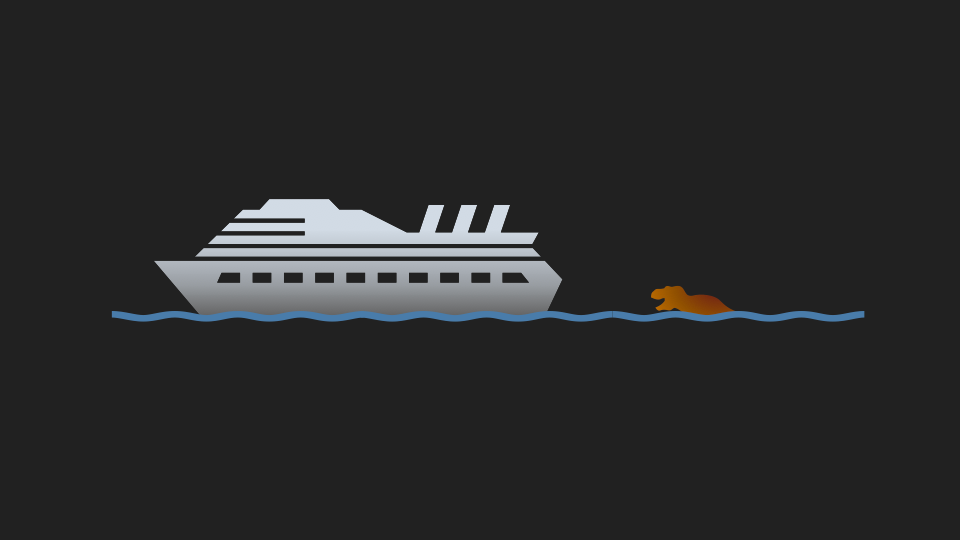
Well, remember the scene in Jurassic Park where Nedry, the evil hacker, steals some dinosaur embryos and tries to escape the island, but encounters what at first seems like a cute, curious little dinosaur? But then that cute little Dilophosaurus hisses and expands his neck frill, and Nedry realizes he has a lot more to deal with that he thought?
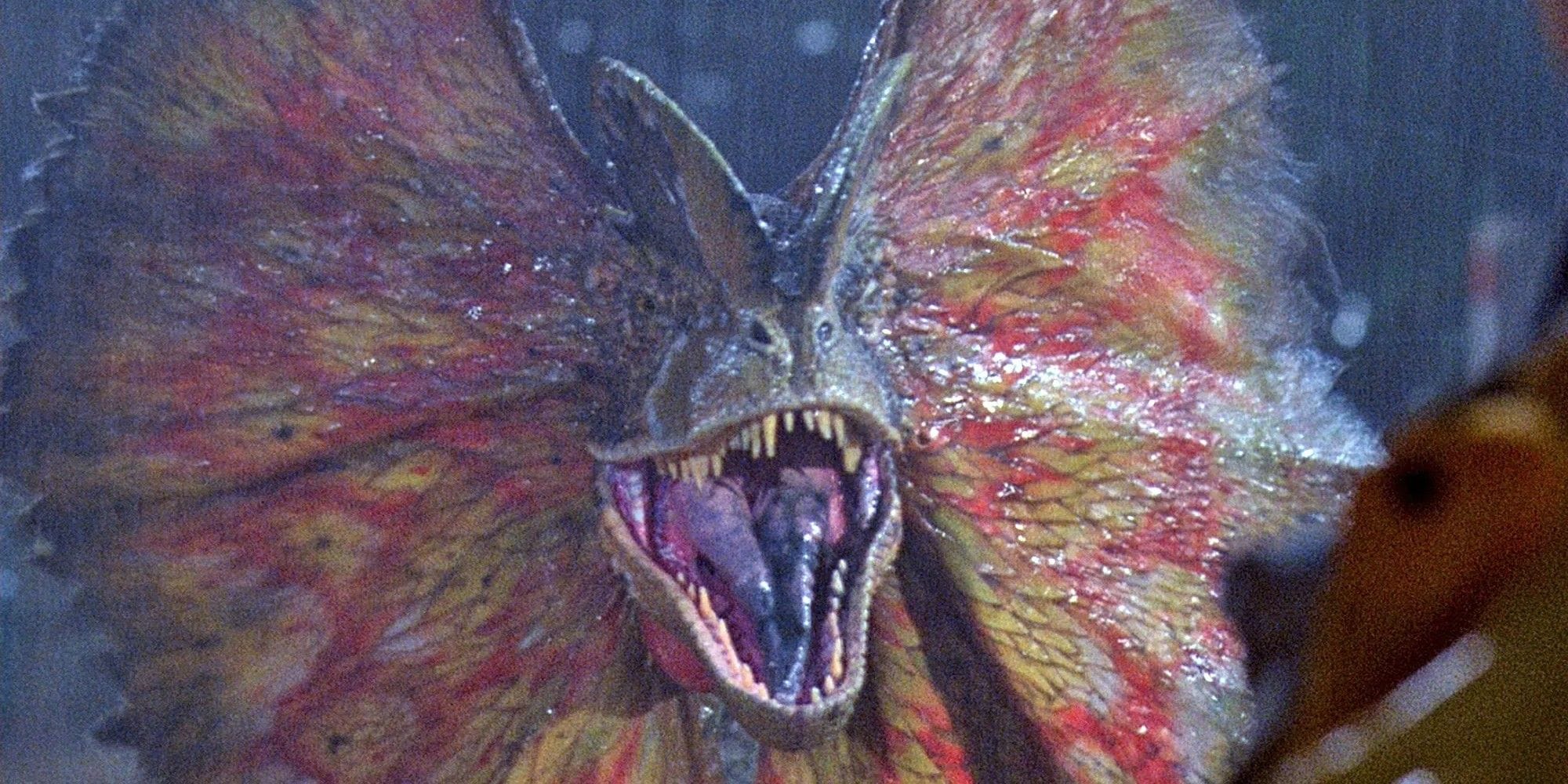
That's kind of how this outline behaved. Whenever I started to expand a paragraph, it kept expanding, like an origami Dilophosaurus. To show what I mean, here’s some notes I took in the middle of wrasslin’ with the thing – also in time-related color:
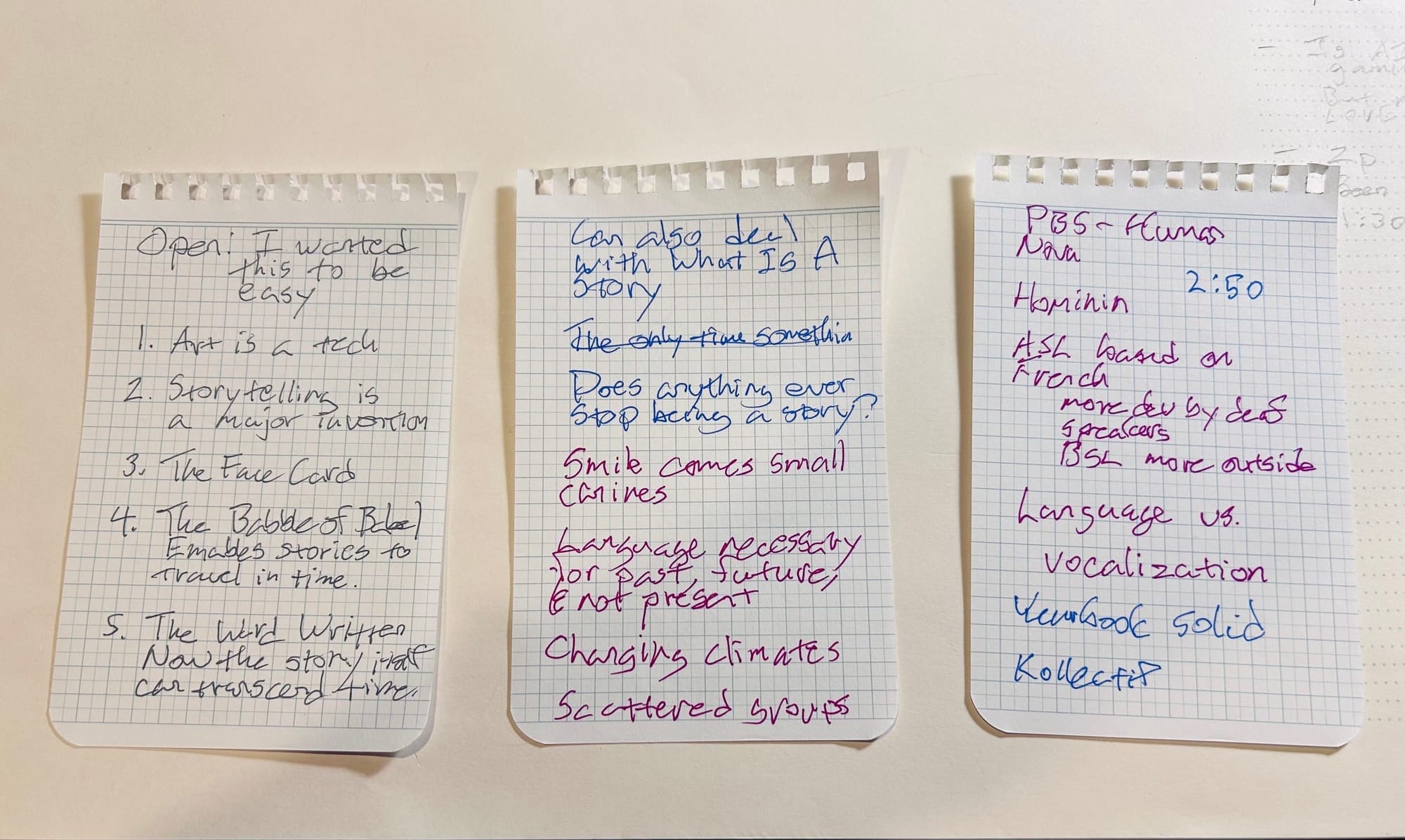
The black ink on the first page starts with my forlorn wish, followed by the five newsletters (count ‘em, five) I felt I’d need to fully expand the initial ideas. Then there’s some topic notes in light blue, following by the magenta notes I took when I interviewed a linguistic anthropology student about a bunch of topics, like story telling, human physical evolution, and different types of language development. (Fun Fact: that linguistic anthropology source is my daughter Kat, a whole human being in her own right).
And then the last two lines in blue are the names of fonts I used when I got overwhelmed with the writing and switched to working on tee-shirt designs (see What’s Going On, above).
“…to arrive where we started…"
In the midst of all this dithering (productive dithering, but still), the question emerged:
Is a five-newsletter deep dive into the development of art as it pertains to human pre-history and physical anthropology, something I really want to write? More importantly, is it something you would want to read?
I don’t have the answers. So let’s try this. Here, in its brief entirety, is that original draft that I dictated in a cabin aboard the Cunard Queen Elizabeth. Have a read, and then let’s talk after:
Art is a technology
We are brains, trapped in skulls, driving bodies. We live in our thoughts – but have no biological way to give these thoughts to others.
So we did what we thinking things do best — we invented tools.
We contorted our faces and bodies to represent feelings, people, and events. We invented storytelling.
We found rocks and plants that left stains on cave walls. We invented painting.
We found a way of making sounds that could represent things and feelings. Consistent, meaningful sounds so someone hearing those sounds would know what we meant. We invented language.
Language is a tool. Storytelling is a tool. Art is a tool. And art and storytelling probably came before language itself. They’re all inventions to transmit thought from one skull to another.
And not only do these tools express thought, they also shape those thoughts, the stories about them, and how they’re presented.
Spoken word requires the audience to be present with the storyteller. And that presence allows physical expression and interactivity.
The written word allows separation between the storyteller and the audience in space and time. But it removes all of the physical expression. So we developed poetry, essays, novels and other formats to use just language to tell stories.
There’s always a connection between the tool and time – what it can recall and what it can preserve and how easily it is understood. Every medium in the toolbox of art gives you unique ways of expression. Each has its strengths, and each lacks features of other mediums.
And this raises an often-asked question: how much of the story is decided by the medium?
Fun facts to know and share
 Sabina Graves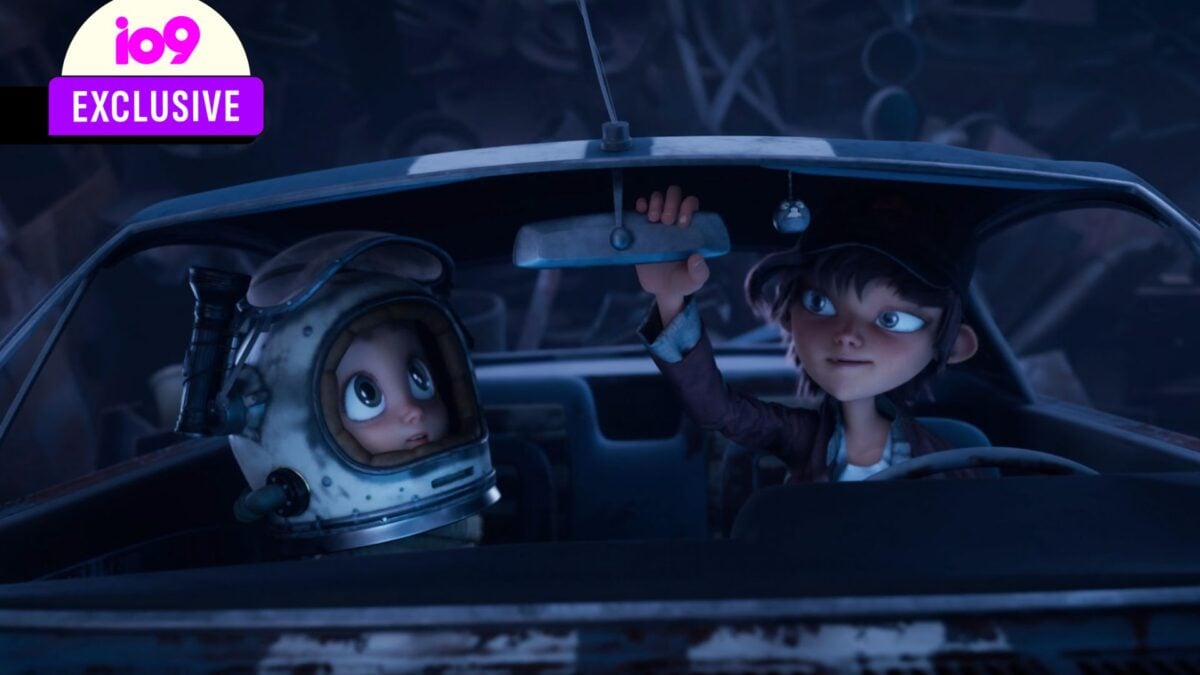
Beautiful, melancholy and hopeful all at once.
 Caroline G.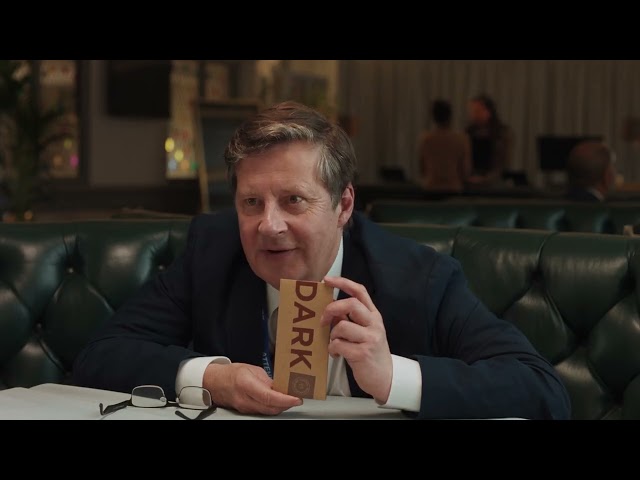
I’ve known these people. On a variety of topics.
I have always wanted to work in Antarctica, but I’m pretty sure I’ve aged out. This documentary is a bit of a consolation, though.
Just finished watching The Sting—great movie. Released in 1973, set in 1939. I regret to inform you that the same time difference is a movie set in 1991. Good. Night!
— Chris Goodman (@cbgoodman.co) 2025-09-29T03:54:08.412Z
[facepalm]
Over to you
So now that you’ve read that short piece burbled into an iPhone off the coast of Alaska, I have questions:
- Did you like the shorter essay form?
- Do you have any questions about the ideas therein? Was there anything that needed more explanation?
- Do you like the behind-the-scenes stuff, or should I keep the mystery alive?
If you could drop a response into the comments, I would be super grateful. And if you can’t, well, I’m already super grateful that you’re reading this newsletter.
Until we talk again, I remain,
Your pal,
Jamie