I only trust what can be haunted
First of all, I highly recommend this article from the New York Times about a local typewriter shop I visited (a couple of times) just this last summer.
Go ahead and click the link below to read it now. But please come back when you’re done. I want to talk to you about ghosts.
(I’ll do the news while I wait for you to get back.)
What’s going on?
- If you’re reading this before Wednesday 17 December, you’ve got a ground-floor opportunity to be a patron of the arts, and maybe pick up some cool swag: the BoneBat "Comedy of Horrors" Film Fest 2026 is holding a Kickstarter to make their 15th year a reality. It's the only comedy/horror film festival in the world, super friendly and smoothly run, and full of amazing finds. Last year, I literally both screamed and laughed – often at the same time. And you could be the new patron that pushes them over their goal.
0.01 hx Ain’t Bad
Almost without meaning to, I find that I have a typewriter collection. Here it is:
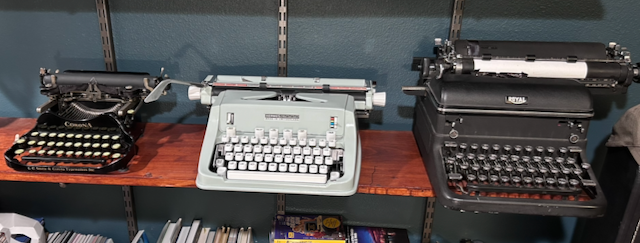
This collection is sized at 0.01 hx, using the typewriter collection measurement unit of the Hanx (which I just made up). The Hanx is based on the approximate size of the typewriter collection of famed collector (and sometime actor) Tom Hanks. To account for natural fluctuations in his collection, the standard Hanx has been set by international committee (again, just me) at 300. So, 3/300 = 0.01 hx.
I know that 0.01 hx doesn’t seem like much, but considering the large (frankly, aspirational) unit size of the Hanx itself, and the number of working typewriters in the average household, 0.01 hx is pretty respectable.
And I owe at least two-thirds of it to the Bremerton Typewriter Shop. Yeah, those folks mentioned in the article I linked above.
That mid-century modern greenish-gray typewriter pictured in the middle of the collection is my Dad’s old Hermes typewriter. It was part of my childhood. I typed high school papers on it. Bremerton Typewriter Shop was able to fully restore it after a lesser shop broke it in several places just trying to clean the thing.
And while we were in the shop, that adorable 1931 folding portable Smith on the left called out to Mari, so of course I got it “for her,” even though it lives in my office. The Royal on the right is an old antique shop find.
The Touch of the Mechanical
I love mechanical devices. Levers, springs, pulleys, all designed to amplify, focus, and redirect your effort to accomplish a specific task. My dad and I both expressed thoughts through the keys on that Hermes A part of our energy and intention moved through and animated that machine.
It’s different than, say, stroking and tapping an iPad. There are so many layers of abstraction to using an iPad – the touch screen, the iPadOS interface, the app you’re using, the API calls that the app uses to get the iPadOS to do what it wants, and then the way the iPadOS chooses to show the result – my intent there is muffled and interpreted.
With a typewriter, it’s all direct and connected. I want to type a “d”, I press the D key, which is actually a lever, linked to a series of levers, that swing a final lever with a “d” on the end of it into the paper. The “d” that appears on the paper is a direct result of my action – in fact, if I strike the key in a wimpy manner (remember to snap the wrist) then I get a gray, wimpy “d.” Crisp snap? Crisp “d.”
Intent, action, result.
And with musical instruments, things can go even deeper.
Prelude to a Prelude
I briefly took piano lessons in my early forties. (No, I didn’t continue. Yes, I should’ve. Yes, I wake up occasionally at 2:00 in the morning thinking about it.)
I had a very specific goal of learning to play Chopin’s Prélude Opus 28, No. 4 in E Minor. It’s sad and beautiful, and beautiful and sad. Have a listen here (it’s just over two minutes long).
About midway through learning the piece, I suddenly realized I was putting my fingers in exactly the same places and sequence as Chopin himself did. And Chopin even wrote down how he wanted me to play it. It’s right there in the music:
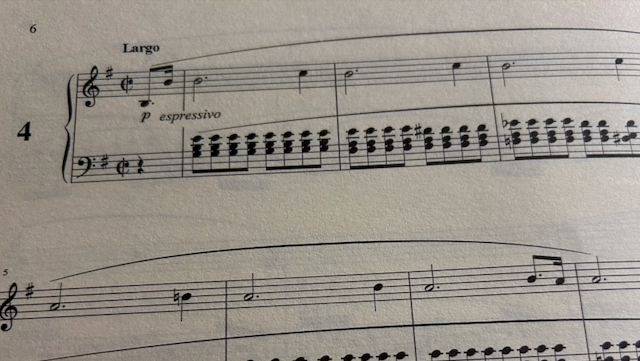
The two sets of five lines (or “staves") running across the page are the notes for your right hand (upper stave) and left hand (lower stave). The height of each note on the stave tells you what key to press on the piano. For instance that first note on the upper stave is a “B”.
The shape of the notehead (the oval part of the note) and its tail tell you how long to hold down the key.
And the spacing of the notes reading left to right tells you what keys to press together.
These are exactly what keys Chopin wanted pressed and when. So when I played the Prelude, I wasn’t just playing the tune, I was operating the piano following instructions direct from the composer himself.
In a way, I was being haunted.
The mechanical nature of the piano (it’s just a harp being hit with felt hammers connected to the keys) means that the sheet music is a ghost of Chopin himself playing the piece. And I was trying to be that ghost. If only for a couple of minutes.
And I feel a bit of that using my dad’s typewriter. Its mechanical nature aligns my current intent and action while using it with that of my father and my younger self. Sure, it’s a little more tenuous a connection. There are twenty six letters, ten numbers (remember 0) and a bunch of special characters, and I’m not using them in the same order as any other manuscript typed on the machine. But the connection is still there.
And in a world where our intermediaries – recordings, photos, even video and audio of our bodies and voices – can be easily faked, I feel like direct connection is going to become more and more valuable.
Right now, I’ve got a literal pile of old iPads that don’t work anymore, and I am not looking to get them restored. They’re gone. Whatever was stored on them went with the data on their drives.
But I just picked up a new Toronto-made thrust action Empire typewriter that I think is from the 1930’s. I’m hoping the good folks at the Bremerton Typewriter Company will be able to restore it. Or at least clean it back to a state of dignity.
Then I get to see if it's haunted.
Fun facts to know and share
 Rebekah Brandes
 sophie.ellisourmedia.co.uk
Over to you
It is, once again, the holiday season. Whether you are facing it with hope or dread or a little of both, I hope you get a chance to take a breath, maybe put your feet up, and congratulate yourself for making it past another winter solstice. Forget those sad sacks in Westeros, summer is coming.
Until we talk again, I remain,
Your pal,
Jamie